
10 Best Frase Alternatives for SEO Briefs and AI Content Writing

Most content teams pick Frase because it pulls SERP outlines together fast, but the excitement fades when the resulting drafts sound just like every competitor on page one.
The era of scraping competitor headlines to publish copycat content is over.
Search engines reward credibility, truth, and genuine human-led insights now, which makes publishing recycled search summaries a direct route to getting penalized by algorithms down the road.
If you want pages that rank and build trust, you need tools that weave real expertise, primary sources, or focused editorial workflows into your briefs.
That might mean an expert-led platform like Leaps, where internal subject matter experts or skilled marketers direct the narrative before drafting starts, or specialized tools built for technical optimization.
To help you pick the right software for your team, we grouped these Frase alternatives by their primary editorial objective. Let's get into the top options.
First, why users look for alternatives to Frase
- The copycat content risk: Scraping top-ranking pages often produces derivative articles that say the exact same thing as everyone else. Search engines prioritize information gain and genuine credibility, which means regurgitated SERP outlines directly harm your organic growth over time.
- Generic AI draft quality: Output built strictly from search aggregators often lacks punch, nuance, and distinctive tone. One Reddit reviewer noted that Frase generated generic and unreliable text structures that required heavy editorial reworking.
- Lack of native expert insights: Frase shows you what already ranks, but it doesn't add proprietary insights from subject matter experts. Your unique human insights must occupy the biggest share of your articles to protect your rankings, yet traditional brief builders don’t weave in those perspectives.
Quick comparison: Top Frase alternatives at a glance
Name | Key Benefit | Best For | Pricing |
Captures asynchronous expert interviews via audio or text and adds fact-checked research before drafting SEO/AEO outlines/ articles. | Editorial teams and B2B marketers who want expert-led, original outlines and content that avoids generic AI slop. | Starts at $49 per month. | |
Delivers user-friendly semantic grading from A++ to F alongside prompt tracking for AI answer engines. | Enterprise editorial teams that prioritize rigorous content grading and seamless Google Docs collaboration. | Starts at $129 per month. | |
Uses patented topic modeling to evaluate domain-wide topical authority and build structured blueprints across multiple formats. | Content strategists who need to plan complete topic clusters and uncover site-level coverage gaps. | Free tier available; paid plans start at $149 per month. | |
Scores drafts against hundreds of on-page ranking factors while tracking brand visibility across AI answer engines. | Technical and growth-focused SEO teams that rely on granular, real-time natural language processing scores. | Starts at $89 per month. | |
Combines a 5-step Cruise Mode blog workflow with community questions pulled directly from Reddit and Quora. | High-velocity content teams that want to transform a target keyword into a formatted first draft quickly. | Starts at $39 per month. | |
Anchors draft sections in verified search concepts and automatically links related pages across your sitemap. | Publishers who want fact-grounded drafts tied to search data and automated internal link deployment. | Starts at $29 per month. | |
Classifies search intent and evaluates multimedia requirements with unlimited user seats for outside contributors. | Agencies and editorial teams that build detailed client briefs with freelancers and external writers. | Starts at $50 per month. | |
Provides section-by-section semantic keyword targets and supports custom OpenAI or Anthropic API keys. | Budget-conscious teams and solo creators seeking affordable semantic optimization without steep subscription fees. | Starts at $23 per month. | |
Embeds keyword difficulty and competitor metrics directly into your browser alongside a rapid outline builder. | Solo marketers and small growth teams that want an approachable AI drafting tool inside Google Chrome. | Starts at $36 per month. | |
Delivers a library of hand-picked, low-competition keywords paired with algorithmic subheadings and post-optimization reports. | Niche bloggers and affiliate publishers who want curated keywords without wading through giant database tables. | $49 per month. |
10 best Frase alternatives for SEO briefs and AI content writing
To help you find the right fit quickly, we categorized these 10 alternatives by their primary editorial objective. That way, you can easily pick the exact platform that fits your specific content strategy and production workflow.
Leaps: Best for expert-led, anti-slop content
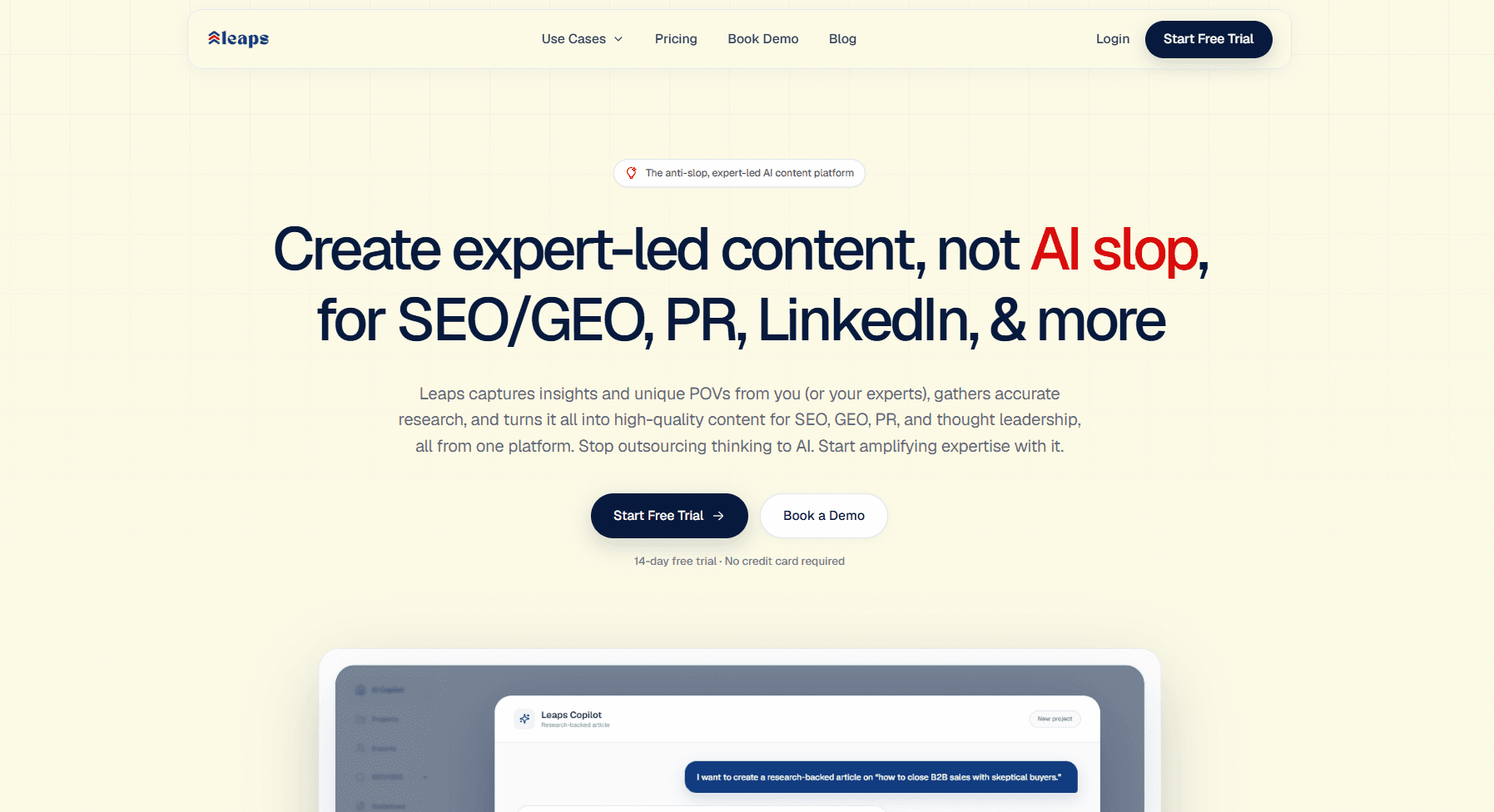
Like I mentioned earlier, most content tools build briefs by scraping the top ten Google search results.
But when everyone copies the same ranking pages, search engines flood readers with identical, uninspired articles. That generic AI slop fails to perform today because modern search algorithms actively penalize copycat material.
Search engines now prioritize credibility, truth, and genuine perspective. That's why Leaps works as an expert-led anti-slop AI content platform. At Leaps, we operate on a clear standard: a single word will not be written until you first go through our interview for each piece, and our research agents have completed extensive research to back your points up with real data.
We built the system for both industry specialists and marketing pros. You might lack niche technical knowledge on a new topic, but you still possess the strategic marketing expertise to structure an argument.
One customer review noted that the platform works like a human journalist asking questions to pull out real insights instead of chasing viral fluff. This upfront interview workflow produces high-credibility drafts that stand apart from standard AI outputs.
Key features of Leaps
- Asynchronous SME interview system: Collects you or your expert perspectives via voice or text prompts. Your team members click a link and record their thoughts without booking calls or creating accounts.
- Ready-made, “anti-AI slop” content workflows: Provides customizable templates for long-form SEO/AEO content (like how-to guides, product alternatives, x vs y comparisons, listicles, etc.), prioritizing your unique POVs.
- Authoritative primary-source research engine: Pulls verified facts, community discussions, and official documentation directly into your drafts with linked citations.
- Anti-AI slop SEO/AEO content writing: Generates complete articles tailored for search engines and generative AI answers, embedding real quotes from your interview phase.
- AI content brief generator for SEO & GEO: Creates structured outlines with section-by-section directions, audience targets, and attached primary proof.
- Leaps Copilot: Guides editorial teams through conversational prompts to produce briefs, long-form articles, and executive thought leadership assets.
- Brand Voice & Style: Lets you save your brand's writing style and guidelines to ensure all generated content is on-brand.
Pros of using Leaps
- Bypasses generic SERP copycat generation by prioritizing original ideas over scraped search results.
- Forces the integration of unique human insights before a single word of the draft begins.
- Eliminates the friction of scheduling live interviews with subject matter experts.
- Validates original perspectives with factual, primary-source research to build credibility.
- Protects organic traffic by aligning with search engine quality guidelines for authentic experience.
Cons of using Leaps
- Requires users to participate in an upfront interview process, which takes more thought than one-click bulk generators.
- Doesn't suit budget publishers looking to quickly spin competitor articles for low-effort affiliate sites.
Leaps pricing:
- Basic: $49/month
- Pro: $99/month
- Premium: $149/month
- Custom: Contact for custom requirements
- Yearly plan available for 20% off.
- 14-day free trial available
Related:
- How to use AI for SEO content writing (without breaking quality)
- 11 AI Tools for SEO and AEO (Prices, Features, Reviews, Etc.)
Surfer: Best for data-driven SEO benchmarking and all-in-one content creation

Surfer made its name as a data-driven benchmark tool for technical SEO teams, but non-technical writers rely on it just as heavily today.
The platform originally focused on outline creation and content optimization, but it has expanded into an all-in-one organic growth engine that handles everything from research to AI drafting.
I like the real-time content editor, and I've used it quite a bit before. It gives you a good idea of how Google is ranking content across your target queries, showing you the exact semantic footprint top competitors use.
But you must use that data carefully. You want to use it in a way that you're not trying to copy all those articles. Instead, use those benchmarks to make sure that you have something that helps you to compete in search, while still leading with original thinking.
Say you run an editorial team writing about cloud infrastructure migration. Surfer pulls the essential entity terms, questions, and heading structures from ranking pages.
Instead of rehashing those same top results, you use those targets to structure your piece, then fill the outline with your engineers' actual migration post-mortems and firsthand benchmark numbers.
Key features of Surfer
- Real-time content editor with content score: Evaluates draft quality on a 0 to 100 scale using live NLP term recommendations, heading targets, and structural metrics.
- AI-powered content briefs and outline builder: Generates search-informed briefs, heading structures, and competitive questions automatically from top search results.
- AI search visibility tracking: Monitors your brand mentions and visibility across generative engines like ChatGPT, Perplexity, and Google AI Overviews.
- Surfer AI and Surfy writing assistant: Drafts complete long-form articles quickly and enables in-line text rewriting and humanization.
- Content audit and decay monitoring: Identifies quick-win updates and keyword cannibalization risks on published pages to protect your rankings.
Pros of using Surfer
- Provides an accurate look into exactly how search engines evaluate and rank content today.
- Features an engaging editor interface. As one review noted, style guides guess at what should rank, but Surfer pulls term coverage directly from pages ranking right now.
- Bridges the gap between technical SEO strategists and non-technical freelance writers with clear, objective scoring metrics.
- Offers a complete production workflow that covers keyword research, brief creation, writing, and post-publish audits.
- Tracks brand mentions in emerging answer engines, which I find particularly helpful given the rapid changes happening across search.
Cons of using Surfer
- The scoring system can feel too rigid. As one Reddit user pointed out, the platform can prioritize keyword density over actual content quality, noting that its AI writer often generates generic fluff for complex topics.
- Strict semantic term targets can compromise natural readability if your writers treat the term list like a mechanical checklist.
- The heavy focus on competitive SERP scraping can tempt writers into blindly copying competitor angles instead of producing fresh, authoritative perspectives.
Surfer pricing:
Surfer bills on a month-to-month schedule, but you can save up to 17% if you pay annually.
- Discovery: $59/month
- Standard: $119/month
- Pro: $219/month
- Peace of Mind: $359/month
- AI Search Analytics: $95/month
- Enterprise: Custom plans starting at $999/month
Related: 12 Best Surfer SEO Alternatives for Outlines & Articles (With Reviews)
Clearscope: The enterprise gold standard for editorial teams

Clearscope is kinda like the gold standard for real editorial teams. It focuses on user-friendly semantic term grading and seamless Google Docs collaboration, giving writers a clean, distraction-free workspace.
When you compare it to Frase, Clearscope edges well on the side of quality.
Frase excels at pulling rapid outlines together from search results, but Clearscope delivers a more sophisticated grading experience that accurately reflects how modern search engines evaluate pages.
Still, keep in mind that its drafts are not natively human-led like Leaps. While Clearscope guides your vocabulary using search data, it doesn't collect firsthand executive quotes or prioritize expert insights before drafting begins.
Consider a busy content team managing ten articles a week with several external freelancers.
Instead of forcing contributors into a separate web app, the editor shares a Google Doc with the Clearscope add-on enabled, letting writers build toward target scores naturally without leaving their drafting flow.
Key features of Clearscope
- AI content brief and outline generation: The platform extracts search intent, competitor subheadings, and core themes from ranking search leaders to build clean outlines in seconds.
- Draft with AI: You can transform your structured briefs directly into detailed, search-aligned first drafts within the native editor.
- Real-time content scoring and grading: The tool grades drafts on an A++ to F scale using semantic relevance, readability levels, and recommended word counts.
- Prompt tracking and AI visibility: Clearscope tracks brand citations and query mentions across generative platforms like ChatGPT, Gemini, and Claude.
- Content inventory and page monitoring: By connecting directly to Google Search Console, the system flags content decay and helps you maintain freshness across published URLs.
Pros of using Clearscope
- Superior grading quality: It delivers exceptional semantic accuracy, helping teams produce better drafts than basic search scrapers.
- Search engine clarity: The platform gives you a clear, data-backed understanding of how modern algorithms evaluate and score topical depth.
- Frictionless document workflow: Writers love the native Google Docs add-on. In fact, freelance writers on Reddit note that it simplifies the writing process and makes it easier to concentrate on solid prose.
- Keyword alignment for teams: It keeps content contributors on track with core topics. An agency user on Reddit noted that the platform makes it simple to verify that writers integrate necessary terms.
- Modern generative visibility: Built-in prompt tracking lets you monitor how frequently conversational AI answers surface your brand.
Cons of using Clearscope
- High entry cost: The monthly pricing makes the platform cost-prohibitive for solo operators and budget-constrained startups.
- Expensive team tiers: Expanding report limits or seat counts gets costly quickly. As one Reddit commenter pointed out, the software runs close to $300 a month on higher tiers, making it a heavy investment.
- Doesn’t prioritize original human insights: The AI drafting still relies on analyzing existing search pages rather than your team’s expertise and insights.
Clearscope pricing:
- Essentials plan: $189 per month
- Business plan: $399 per month.
- Custom: Contact for Enterprise pricing.
Related: 11 Clearscope Alternatives (#1 Avoids Copycat Content)
MarketMuse: Best for enterprise content governance and site-wide topical authority mapping

MarketMuse takes an entirely different path than other content optimization tools.
It’s an OG tool for planning entire topic clusters and uncovering domain-level content gaps across your entire website.
Instead of relying on shallow SERP scraping that creates copycat content, MarketMuse uses patented topic modeling to measure true topical depth. It helps you see what a comprehensive resource should cover before you write a single word.
This platform shines brightest for enterprise marketing teams, agency strategists, and large publishers managing thousands of URLs.
If you run a massive B2B knowledge base, optimizing one page in isolation will not move the needle. You need to know which subtopics your entire domain ignores, and MarketMuse pinpoints those exact authority deficits.
Large organizations rely on this deep approach to build sustainable organic search moat. In fact, an enterprise marketer on Reddit noted that MarketMuse produced remarkable results at a very high enterprise level when used properly.
Key features of MarketMuse
- Patented topic modeling & real-time content scoring: Analyzes subject matter depth against rigorous competitive benchmarks rather than counting basic keyword repetitions.
- AI-powered content brief generator: Builds automated blueprints across nine distinct content formats with suggested subheadings, key questions, and relevant internal links. A marketer in a Reddit thread called these briefs an invaluable resource that speeds up content planning by clearly structuring every outline.
- Automated content inventory & authority auditing: Crawls your entire domain to calculate personalized difficulty scores, showing you topics where your site holds authority versus queries requiring extra support.
- Optimize AI writing assistant: Delivers in-editor prompts that allow writers to expand, summarize, and restructure drafts while keeping a human subject expert in control.
- Competitive SERP X-Ray & heatmaps: Visualizes side-by-side gap analysis across the top 20 search listings so editors can spot competitor blind spots immediately.
Pros of using MarketMuse
- Evaluates content quality using patented semantic topic modeling instead of raw keyword stuffing metrics.
- Acts as a powerful governance engine that analyzes full website architectures and organizes large topic clusters.
- Generates detailed editorial briefs that give freelance and in-house writers clear structural direction.
- Calculates personalized ranking difficulty tailored to your actual domain authority rather than generic third-party scores.
- Maintains a respected legacy reputation among technical SEO directors and enterprise content leaders.
Cons of using MarketMuse
- Carries high subscription costs geared strictly toward enterprise budgets. For example, one Reddit commenter evaluating the platform noted receiving an annual sales quote of $18,000 for a single website property.
- Requires going through sales demos because the vendor keeps paid tier pricing hidden from the public site.
- Presents a steep learning curve and excess complexity for solo creators who only need to outline single blog posts quickly.
MarketMuse pricing:
- Free: $0 per month. Includes basic query allowances and access to single-page applications.
- Optimize: Custom quote based on team size and domain scope (requires scheduling a sales demo).
- Strategy: Custom quote tailored for full-scale domain inventory tracking and multi-brand governance (requires scheduling a sales demo).
NeuronWriter: Best for budget-conscious creators seeking cost-effective NLP optimization

If you want strong content optimization without paying enterprise software prices, NeuronWriter is easily the most cost-effective Frase alternative on the market.
It delivers deep natural language processing (NLP) recommendations and automated drafting at a fraction of the cost of traditional SEO tools. The depth of data stands out right away. In one AppSumo review, a user pointed out that NeuronWriter provides a more complete page optimizer with a better range of NLP terms and greater flexibility across different AI writers than competing tools.
Personally, I love that the platform supports a Bring Your Own Key (BYOK) model. Connecting your own OpenAI or Anthropic API keys gives you complete control over your generation costs while bypassing restrictive credit limits.
As we discussed earlier, the era of relying on copycat AI content is over. Scraping competitor search results will only set your site up for trouble once search engines flag repetitive text. If you choose NeuronWriter, you must make sure you do not overly rely on it to replace your own human intent.
Think about writing an article on customer retention strategies for SaaS brands. NeuronWriter will quickly pull every term your competitors use, like "churn rate" and "onboarding sequences."
But if you don't add your own real churn data, customer interview snippets, or unique industry perspective, your article will read just like the top ten results already sitting on Google.
Unlike Leaps, which structurally requires you to record expert insights before writing starts, NeuronWriter leaves the job of injecting human value entirely to you.
Key features of NeuronWriter
- Bring Your Own Key (BYOK) support: Connect your personal OpenAI or Anthropic API keys directly to the platform. This lets you bypass standard monthly generation limits and choose the exact model you want to power your drafts.
- Section-specific NLP draft mode: The editor generates semantic keyword recommendations tailored to each individual subheading in your outline, rather than dumping one massive keyword list across the entire document.
- Content designer long-form AI writer: Pulls heading structures from ranking competitors and pairs them with generative templates to build full-length outlines and article drafts quickly.
- AI profile brand customization: Scans your domain and existing subpages to align new drafts with your established brand voice, target customer personas, and core product positioning.
- Multi-engine brand citation tracking: Tracks how often your domain appears as a cited source across generative search tools like ChatGPT, Perplexity, and Google AI Overviews.
Pros of using NeuronWriter
- Provides an entry price that beats nearly every major competitor in the SEO content space.
- Delivers a thorough page optimizer with a wide variety of semantic NLP keyword suggestions.
- Grants flexible generation limits by allowing direct API connections to OpenAI and Anthropic models.
- Produces well-structured drafts that read smoothly out of the box. A marketer on Reddit shared that the drafts read cleanly and pass AI detectors, though they still require human adjustments and SEO tuning.
- Supports multi-LLM workflows for lean marketing teams without charging expensive per-seat fees.
Cons of using NeuronWriter
- Lacks original expert insights in final draft, which makes it easy to produce generic AI text if you rely too heavily on automation.
- Demands hands-on editing and manual SEO adjustments after generation to verify factual claims and maintain clear human intent.
- Relies on existing search engine results for outline suggestions, creating a risk of copying competitor angles instead of presenting fresh ideas.
NeuronWriter pricing:
- Bronze: $23 per month for single-project management and 25 content analyses.
- Silver: $45 per month for growing websites needing 50 content analyses.
- Gold: $69 per month for teams needing 75 content analyses, content sharing, and internal linking recommendations.
- Platinum: $93 per month for agencies managing up to 10 projects and 100 content analyses.
- Diamond: $117 per month for large operations requiring unlimited projects and 150 content analyses.
Content Harmony: Best for search intent analysis and driving information gain

I view Content Harmony as a dedicated search intent specialist. While many tools rush to spit out generic paragraphs, Content Harmony helps your editorial team analyze multimedia requirements, forum discussions, and intent categories before anyone writes a single word.
The question and forum research feature stands out as the real winner here. To win in modern search, you need to add a lot of information gain to your content. If your article simply rehashes the exact same headings as the top five search results, you give readers zero reason to stay.
Uncovering fresh questions from real communities changes that dynamic. Adding this unique information gives traditional search engines and newer AI search engines a reason to index and surface your pages over competing articles.
For example, if you build a brief on enterprise cloud migration, standard tools suggest generic definitions. Content Harmony pulls actual headaches engineers discuss on Reddit, giving you unique talking points right away.
Keep in mind that while gathering forum intent gives you an edge, scraping existing discussions only gets you halfway there. You still need genuine human insight to turn those discovered questions into authoritative answers.
Key features of Content Harmony
- Question and forum research: Content Harmony extracts discussions from Quora, Reddit, and People Also Ask. This highlights unaddressed reader pain points so you can inject fresh perspectives into your outline.
- Search intent classification engine: The software analyzes top-ranking pages to identify primary intent types, keeping your draft outlines aligned with Google search standards.
- Visual and multimedia content analysis: The system scans competitor pages for diagrams, images, and videos. This shows your writers exact media requirements instead of leaving graphics as an afterthought.
- Data-driven SEO content brief builder: You can build standardized assignments using block-based templates that import highlighted search data. A freelance writer on Reddit explained that pulling heading architectures this way pinpoints basic gaps very quickly.
- Unlimited user collaboration: Every tier includes unlimited user seats and shareable web links. In one G2 review, a user explained that the platform cut brief-building time in half while delivering valuable internal linking suggestions.
Pros of using Content Harmony
- Extracts real audience questions from forums like Reddit and Quora, making it easy to drive information gain.
- Classifies search intent automatically to keep outlines aligned with search engine expectations.
- Analyzes visual and multimedia usage across competitors, offering a more complete brief than text-only tools.
- Includes unlimited team seats and free shareable links on all plans, making it ideal for client-facing agencies.
- Drastically reduces the manual, time-consuming research phase for SEO strategists and editorial leads.
Cons of using Content Harmony
- Provides less robust in-editor content optimization scoring compared to dedicated grading platforms like Surfer.
- Focuses heavily on brief building and search intent research rather than full-length AI article generation.
Content Harmony pricing:
- Standard - 5: $50/month for 5 content briefs.
- Standard - 12: $99/month for 12 content briefs.
- Standard - 25: $199/month for 25 content briefs.
- Standard - 50: $299/month for 50 content briefs.
- Standard - 100: $599/month for 100 content briefs.
- Standard - 150: $799/month for 150 content briefs.
- Enterprise: Custom plans starting from $1,000/month for high-volume organizations.
You can also access discounted rates on annual plans, or purchase a one-time $10 test run that includes 10 workflow credits.
Outranking: Best for factual AI drafting and automated internal linking

Outranking positions itself as a factual accuracy tool that turns competitor concepts and live search data into tightly structured first drafts.
If your editorial team struggles to standardize on-page SEO workflows or build consistent outlines quickly, this platform speeds up that front-end research.
For me, the automated internal linking engine stands out the most. Linking internally to related pages you already published remains a very powerful on-page SEO tactic and a major ranking factor for your overall content strategy.
Outranking connects directly to your sitemap, scans your catalog, and inserts relevant internal links without forcing you to dig through spreadsheets.
As one AppSumo user noted, the platform extracts core concepts and key facts from top search results so writers do not have to spend hours analyzing SERP data manually. Similarly, one SEO discussion highlighted how the software pulls audience questions across search engines, Quora, and Reddit to help writers address what readers actually care about.
But I have to share a serious warning about this workflow. Scraping content from live SERP results is a recipe for disaster months or years down the line. When you rely solely on scraped outlines, your articles start to look identical to every competitor page in Google. Search algorithms eventually penalize unoriginal copycat writing.
Key features of Outranking
- Fact-grounded AI first drafts: Anchors generated paragraphs directly in verified SERP facts and entity concepts rather than open-ended model output.
- Automated internal linking engine: Connects to your sitemap to scan existing articles and automatically inserts contextually relevant internal links.
- SERP-driven SEO brief generator: Pulls competitor headings, search intent breakdowns, and target queries into structured outlines.
- Real-time 40-factor on-page scoring: Assesses draft quality against dozens of on-page ranking factors, semantic terms, and keyword density rules.
- E-E-A-T and originality optimizer: Evaluates content against search quality guidelines and integrates plagiarism checks to verify originality.
Pros of using Outranking
- Automates the internal linking process, serving as a powerful and time-saving on-page SEO tactic.
- Reduces AI hallucinations by anchoring draft creation in verified, real-time search engine facts.
- Speeds up the initial outlining phase by structuring competitor gaps and intent into detailed briefs.
- Provides granular, 40-factor on-page scoring to verify technical SEO requirements before publishing.
- Includes built-in E-E-A-T scoring to align output with modern search quality guidelines.
Cons of using Outranking
- Scraping live SERPs can result in generic, copycat content if your team relies too heavily on raw AI output.
- Drafts cannot go straight to publication without heavy human editing and original insights to avoid search penalties over time.
Outranking pricing:
- Starter: $19/month
- SEO Writer: $79/month
- SEO Wizard: $159/month
- Enterprise: Custom tier available upon inquiry.
Scalenut: Best for high-velocity blog building

If you want to move from an initial keyword idea to a fully drafted post in minutes, Scalenut fits the bill. I frame it as the high-velocity blog builder for marketing teams that need speed but still want hands-on control over their editorial narrative.
Most AI writers just scrape competing search pages and generate bland copycat text. But I like that Scalenut lets you direct the content using talking points for every heading. You can tell the model exactly which argument to make, rather than leaving the draft to chance.
Scalenut also pulls questions and discussion threads straight from Reddit and Quora. That context gives your outlines real audience perspective instead of recycled search snippets.
For example, if you draft a guide on payroll software, Scalenut pulls actual complaints about setup fees directly from user forums so you can address them immediately.
Another standout feature for me is the generative engine optimization (GEO) visibility tracking. Potential customers are asking AI tools about your product category every day, so tracking where you show up helps you pinpoint where you need to improve.
As a contributor in a blogging forum thread pointed out, Scalenut builds a complete draft in minutes from search analysis, leaving you time to add personal polish.
Key features of Scalenut
- Cruise Mode AI writer: Guides you through a 5-step automated workflow that turns simple outlines into long-form drafts in minutes.
- Automated SEO content briefs: Extracts competitor headings, topic gaps, and forum questions into structured assignment outlines.
- Generative engine optimization (GEO) visibility: Tracks brand mentions and organic citations across answer engines like ChatGPT and Perplexity.
- Reddit and Quora integration: Pulls real community discussions to give your drafts better context and genuine audience alignment.
- Talking point direction: Lets you guide the AI generation process by mapping out specific arguments and facts for each section.
- Real-time content optimizer: Grades your draft against semantic NLP terms, readability scores, and structural benchmarks from top search results.
- Automated internal linking and CMS publishing: Recommends contextual internal links and publishes drafts directly to WordPress and Shopify.
Pros of using Scalenut
- Moves your team from keyword ideation to a fully drafted long-form post extremely fast.
- Tracks your organic visibility across modern generative AI answer engines.
- Pulls actual audience questions and contextual insights from real Reddit and Quora discussions.
- Gives you tight control over the AI text through dedicated talking points.
- Consolidates keyword planning, topic clustering, and competitor research into one flow.
Cons of using Scalenut
- Generates copy that can feel repetitive if you rely strictly on competitor search data without your own point of view.
- Demands heavy human editing and original insights after generation to make your brand voice stand out. As another Reddit discussion warned, leaning too hard on optimization checklists often makes articles feel stiff and less enjoyable to read.
Scalenut pricing:
- Starter: $59/month
- Plus: $89/month
- Professional: $199/month
- VIP Service: Custom pricing available for enterprise setups.
GrowthBar: Best for Beginner-Friendly, In-Browser AI Drafting

GrowthBar positions itself as the most approachable, beginner-friendly alternative for solo marketers and lean teams who want simple AI drafting directly in their browser.
If you want to bypass complex enterprise platforms and build drafts quickly, it gives you a straightforward way to research search queries without leaving your active tab.
The GrowthBar Chrome extension stands out the most to me here. It surfaces keyword difficulty, domain authority, and competitor insights directly inside Google search results and WordPress.
In evaluating practical SEO tools, a Reddit practitioner noted that GrowthBar works particularly well for grabbing a quick SEO snapshot while browsing.
But I have to issue a serious warning about this workflow. Scraping top search listings might produce quick drafts today, but search engine algorithms will eventually catch up with all the spam and copycat content filling the web. You’d also have to spend a lot of time editing to add human insights and remove any AI slop.
Key features of GrowthBar
- GrowthBar Chrome extension: Surfaces keyword difficulty, domain authority, and competitor insights directly inside Google search results and WordPress.
- 2-Minute AI blog builder: Converts structured outlines into 1,500+ word draft articles with drag-and-drop heading organization.
- AI SERP outline and brief generator: Scans Google search results to pull suggested headings, target keywords, and links in one click.
- Custom AI models for brand voice: Trains the writing assistant on your own top-performing content to reflect your team's tone.
- Competitor intelligence tracker: Uncovers organic search keywords, backlink profiles, and estimated ad spend for competing domains.
Pros of using GrowthBar
- Intuitive and beginner-friendly: Solo founders and generalist marketers can create content quickly without navigating technical SEO software.
- Frictionless Chrome extension: Brings keyword difficulty and competitor data straight into your browser. One Product Hunt review shared that the extension helped their team research keywords, name pages, and track search terms with minimal effort.
- Rapid outline assembly: Drag-and-drop functionality lets you turn live search headings into a working draft outline in minutes.
- Voice customization options: Custom models help train the system on your past articles, preventing overly dry, generic AI phrasing.
Cons of using GrowthBar
- Heavy reliance on competitor scraping: Generating articles purely from scraped SERP data produces copycat content that risks algorithmic search penalties over time.
- Lacks human insights: The software doesn't prioritize proprietary data or unique perspectives.
- Limited enterprise utility: It skips the advanced content governance, topic modeling, and detailed scoring systems that larger editorial teams require.
GrowthBar pricing:
- Standard: $36/month
- Pro: $74.25/month
- Agency: $149.25/month
RankIQ: Best for niche blogging and rapid optimization
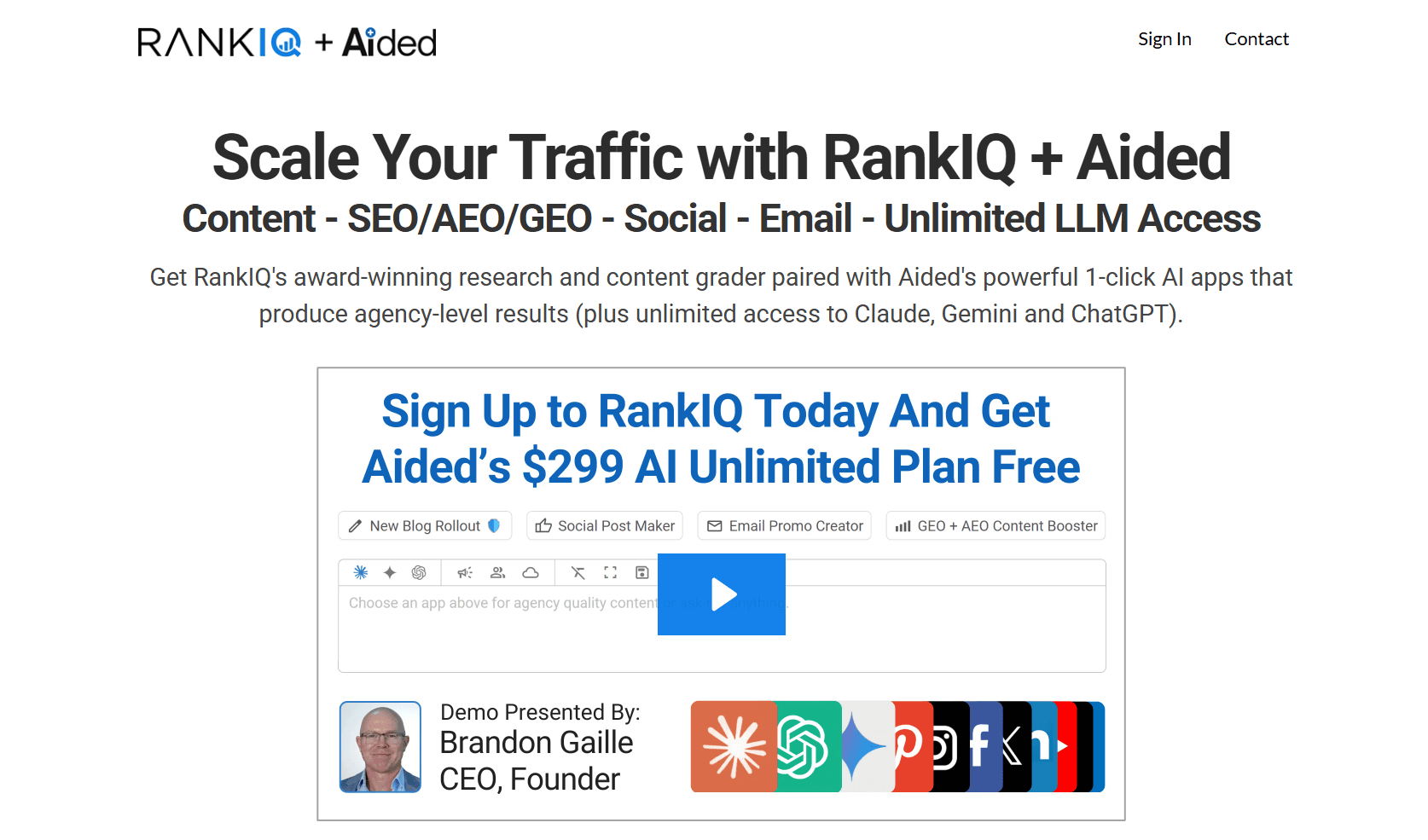
RankIQ strips away complex enterprise metrics and positions itself as the practical alternative for niche bloggers and affiliate publishers.
Instead of forcing you to decipher complex technical SEO dashboards, the platform focuses on curated keyword lists and rapid optimization.
I think the curated niche keyword library has to be the winner for me. Most legacy SEO platforms dump a bunch of keywords in a table for you to sort and pick, leaving you to guess which terms you can actually win.
RankIQ relies on human experts who handpick low-competition targets, creating a real welcome differentiation in a crowded market.
Consider a solo creator running a food blog who wants to write about sourdough baking. Instead of spending three hours filtering raw search volume in complex spreadsheets, you pick an expert-vetted long-tail query from the library and generate an algorithmic brief in minutes. As one Reddit review pointed out, the basic interface removes the complexity of SEO for publishers who want to learn the ropes without getting overwhelmed.
Key features of RankIQ
- Curated niche keyword library: Delivers hand-picked, low-competition keywords across hundreds of specialized blogging niches.
- Algorithmic SEO content briefs: Generates targeted reports detailing recommended word counts, key subheadings, and semantic keywords from top 30 search results.
- Old post optimization engine: Guides step-by-step audits to rewrite and re-optimize underperforming legacy content in under 30 minutes.
- Multi-LLM AI content drafting: Integrates with the Aided AI platform to generate one-click articles utilizing Claude, Gemini, and ChatGPT.
- SERP-backed title generator: Analyzes top-ranking search listings to identify high-click-through headline formulas and terms.
Pros of using RankIQ
- Human experts handpick every query, delivering better quality and relevance than purely automated bulk lists.
- The clean, approachable interface removes the steep technical hurdles common in traditional SEO tools.
- The tool sorts and vets ranking opportunities for you, giving you clear differentiation from bloated database platforms.
- Step-by-step audits help you systematically turn older posts with low search grades into fully optimized articles.
- Built-in access to Claude, Gemini, and ChatGPT lets you generate initial drafts directly inside your workflow.
Cons of using RankIQ
- As another Reddit commenter noted, the tool works mainly as an on-page optimizer for specific long-tail queries rather than a comprehensive domain discovery platform.
- The platform omits detailed backlink analytics, technical crawling, and sitewide rank tracking needed by large corporate teams.
- The built-in AI drafts content by summarizing existing top search results. Publishing purely scraped SERP summaries creates repetitive content that search engines eventually penalize, meaning you still must infuse your own unique human insights to stand out.
RankIQ pricing:
RankIQ offers a single promotional pricing tier at $49 for their unlimited tier.
Frequently Asked Questions About Alternatives to Frase
Why are content teams looking for Frase alternatives?
I think that's one main reason teams look for alternatives: they need to avoid generic AI slop that search engines no longer reward. The search landscape changed dramatically over the last year.
For years, software like Frase helped content teams scrape top Google results, piece together common subheadings, and rephrase existing articles. But the era of scraping live search results to publish copycat content is completely over.
Search engines now demand credibility, truth, and unique, human-led ideas. When every article in the search results summarizes the exact same five competitor pages, modern search algorithms notice the lack of value.
What is the main risk of using AI content generators that scrape SERPs?
Generating content purely from scraped competitors is a recipe for disaster. It might bring quick search impressions at first, but search engine algorithms will eventually catch up with the spam and copycat text.
I see teams run into trouble when they scrape the top five results for a topic and let AI stitch together a draft. After a search update rolls out, their rankings drop because their pages look identical to every other article on the web.
Search engines reward credibility and real information gain, not recycled talking points. If you analyze competing search results, use that scraped data only for high-level inspiration. Never send those AI drafts straight to publication.
Instead, make sure your own human insights take up the biggest footprint in your content. Ground your drafts in real expert interviews and proprietary viewpoints, or use expert-led tools like Leaps to capture original thoughts before you write.
Do I need to be an industry SME to produce expert-led content?
Not at all. Expert-led content doesn't only come from technical engineers or executives with decades of niche field experience.
It also comes from marketing professionals who know how to construct a sharp, persuasive argument. You might not run daily operations in a specialized sector, but you possess professional marketing expertise that frames problems, challenges bad advice, and guides buyers.
At Leaps, we approach content creation with this exact reality in mind. The platform runs a focused interview before generating a single word, gathering your distinct opinions and strategic points through quick text or voice notes. It pairs your direct arguments with fact-checked research, making sure the piece stands out from generic search engine recaps.
How can I ensure my AI-written SEO content doesn't sound generic?
If you want your pages to stand out and rank, you need to infuse genuine human experience into your workflow before drafting begins.
Here are three practical ways to keep your AI content original:
- Use SERP outlines for inspiration, not production: Treat competitor headings as a rough guide to search intent. Never send scraped outlines straight to your CMS without adding your own unique angles, takeaways, and arguments.
- Capture expert perspectives first: Interview your internal team, marketing leads, or niche practitioners before writing a single word. Platforms like Leaps make this simple by running asynchronous interviews via audio or text, capturing authentic human viewpoints that AI cannot invent.
- Anchor claims in verified primary sources: Pair expert commentary with fact-checked data points from customer feedback, community threads, or original studies. Fresh evidence gives readers and search engines real value that generic models overlook.
When your unique human insights drive the core narrative, AI becomes an assistant that speeds up production rather than a tool that generates generic slop.
Choosing the Best Frase Alternative for AI Content Writing
Selecting the right platform comes down to where your editorial bottlenecks actually live and what your specific content goals are.
But whichever platform you pick, remember that search engines no longer tolerate recycled outlines. If your primary goal is building content that avoids AI slop and the copycat trap entirely, Leaps provides the most direct path forward.
By requiring an upfront expert interview before generating a draft, it protects your brand reputation and positions your content to win in modern search.
Victor Ijidola
Hi, I’m Victor Ijidola, co-founder @ Leaps, the anti-AI slop expert-led AI content creation platform that helps you create expert-led content with AI that amplifies your thinking, not replaces it. I'm also a professional content marketer for B2B and SaaS brands, and my work has been published by Entrepreneur, CXL, Inc.com and many more.